
Key Takeaways:
- Cloud flaws in IoT equipment allow hackers unauthorized access to camera feeds without a password.
- A traditional home firewall lets this attack through because the camera defaults to having permission to send video to the internet.
- GADNET isolates such devices in a Zero Trust zone and uses artificial intelligence (ML) to immediately cut off strange network traffic.
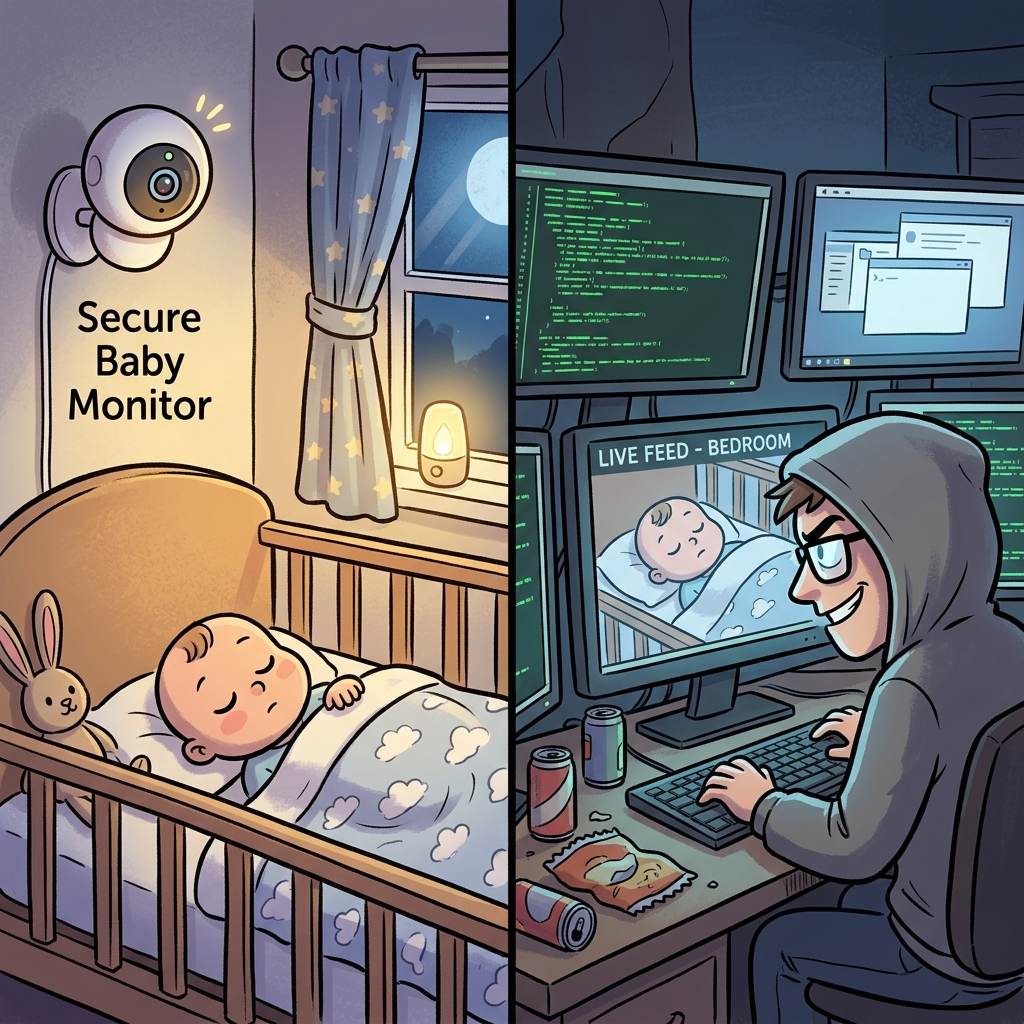
When we were discussing the latest cybersecurity report over coffee a few mornings ago, a dead silence fell over the room. A French researcher revealed that widely used electronic baby monitors contain massive cloud security flaws allowing anyone - without needing a password - to look straight into the bedrooms of thousands of children globally. Terrifying events like this clearly demonstrate the absolute necessity of implementing uncompromising defensive solutions like GADNET in our homes. They highlight exactly why we so desperately need to escape outdated, “flat” networks.
The Invisible Enemy vs. Traditional Firewalls
The main problem with the flaws found in these massive electronic baby monitor leaks isn’t how the camera works locally. The problem is that the external cloud infrastructure of the providers completely failed.
Most of us have a standard router from our internet service provider. Its built-in firewall relies on static rules. If the rule says “allow the camera to send a video stream to the internet”, the firewall will do it without batting an eye. It cannot distinguish whether the parent is watching the feed on their smartphone or a hacker on the other side of the globe is downloading image thumbnails. That’s exactly why we must move from asking “is this allowed?” to “is the behavior of this camera normal?”.
Solution Comparison
| Feature | Traditional Router | GADNET ML + Zero Trust |
|---|---|---|
| Camera network access | Full, unrestricted across the entire home | Locked in an isolated IoT zone |
| Sending video outward | Firewall allows everything out | Strict monitoring of data direction and volume |
| Anomaly response | No reaction | Automatic Quarantine and phone alert |
ML Algorithms in the Service of Privacy
The Zero Trust architecture built into GADNET assumes that the camera in your child’s room is a potential spy. From the moment it connects to the network, it lands in an isolated virtual “prison” (IoT VLAN), cut off from the laptop where you have your bank account open.
But that’s not all. The most critical line of defense is our built-in artificial intelligence module. This system constantly utilizes multi-tiered Machine Learning algorithms to learn exactly how your specific electronic baby monitor behaves:
- What times it usually transmits data.
- Which specific servers (IP addresses) it hits.
- How much bandwidth it consumes.
If suddenly in the middle of the night, due to a software flaw, the camera attempts to establish a new connection with a suspicious, unprecedented server, or begins massively sending out video streams that repeatedly exceed its baseline - the classification algorithm raises an escalation alert. The device instantly loses internet access, and the administrator (you) receives a notification in the configured application. Your home is safe once again.
FAQ
Why aren't camera firmware updates enough?
Does GADNET's ML mechanism send my traffic data to an analytics cloud?
Sources and Further Reading
Technical details and the original report regarding the described electronic baby monitor vulnerabilities can be found in the following materials: