
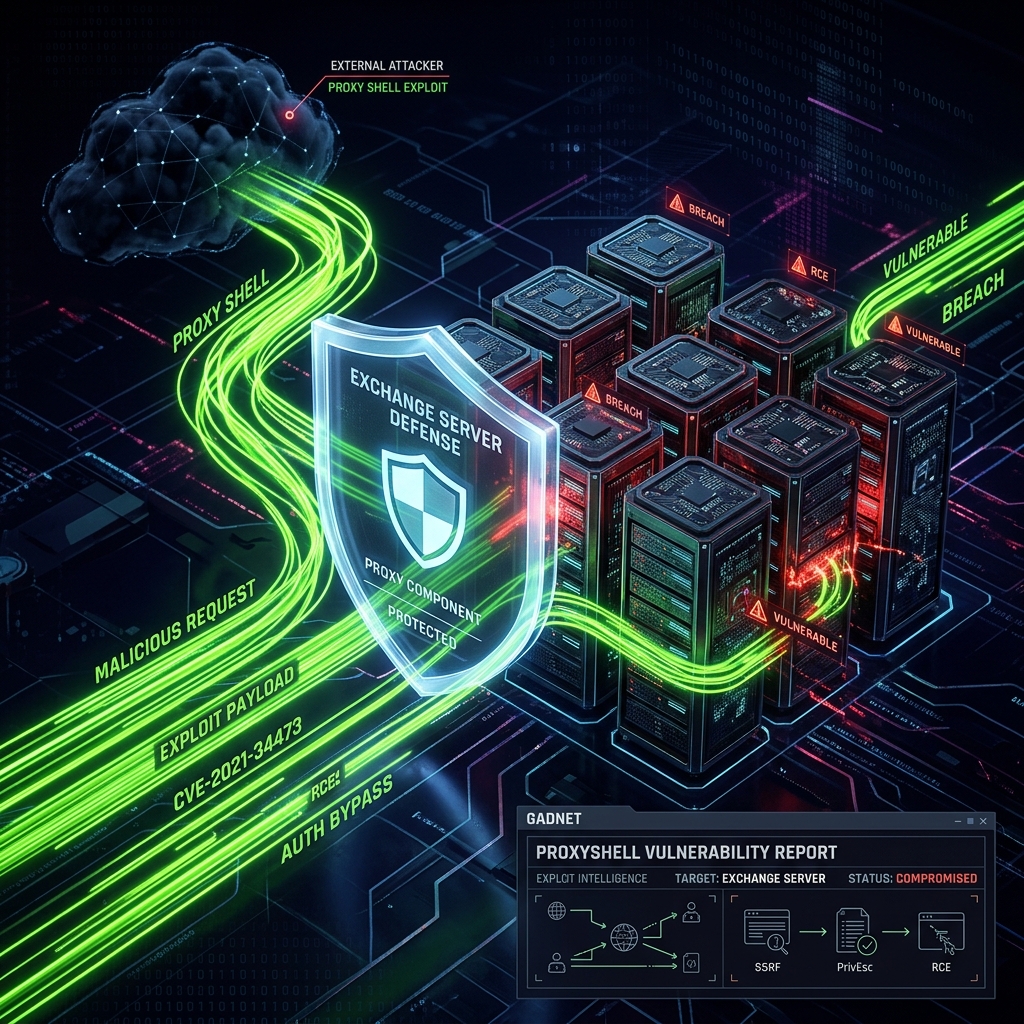
Key Takeaways:
- ProxyShell is a chain of three vulnerabilities (CVE-2021-34473, CVE-2021-34523, CVE-2021-31207) allowing full unauthenticated server takeover.
- The flaws resulted from “technical debt” and inconsistencies between the frontend and backend layers in Exchange.
- The discovery earned the researcher a $200,000 reward at Pwn2Own 2021.
When we first analyzed the architecture of the ProxyShell vulnerability in the GADNET lab, we rubbed our eyes in disbelief. The bugs were not about a classic buffer overflow. Orange Tsai proved how dangerous “technical debt” can be in massive corporate systems. Breaking down the communication between the frontend and backend in Microsoft Exchange, we remembered why the principle of limited trust (Zero Trust) is the absolute foundation of today’s networks.
What was ProxyShell?
ProxyShell was not a single bug, but an intricately connected chain of three different “zero-day” vulnerabilities. They allowed an external attacker (without needing any passwords) to take full control over the mail server via the standard port 443 (HTTPS).
The chain consisted of the following elements:
- CVE-2021-34473 (Pre-auth Path Confusion / ACL Bypass): An authentication bypass bug.
- CVE-2021-34523 (Elevation of Privilege): Escalating privileges in the PowerShell backend.
- CVE-2021-31207 (Post-auth Arbitrary-File-Write / RCE): Injecting malicious code.
Why were Orange Tsai’s discoveries groundbreaking?
Most security researchers look for memory leaks. Orange Tsai approached the subject architecturally. He analyzed the fundamental change from 2013, where the CAS (Client Access Service) was divided into frontend and backend layers.
The lack of consistency in how both layers verify privileges and route HTTP requests opened up a completely new attack surface.
Comparison: Traditional Approach vs. Zero Trust
| Approach | Privilege Verification | Impact of Architectural Attack |
|---|---|---|
| Traditional model (like the analyzed Exchange) | Inconsistencies between frontend and backend | Complete server takeover (RCE) |
| GADNET Zero Trust approach | Strict segmentation and continuous authorization | Restricting lateral movement and isolating the threat |
Consequences and Legacy
The bugs discovered by the researcher forced Microsoft to make architectural changes and release urgent updates. Due to patching delays by administrators, these vulnerabilities became the most frequent vectors of ransomware attacks in subsequent years. Today, Orange Tsai’s presentations are an absolute world masterclass in Enterprise Security.