
Key Takeaways:
- Hackers are mass-collecting intercepted data today to break it in the future.
- Quantum computers will easily decrypt today’s security methods.
- GADNET implements Post-Quantum Cryptography (PQC) right now to block this tactic.
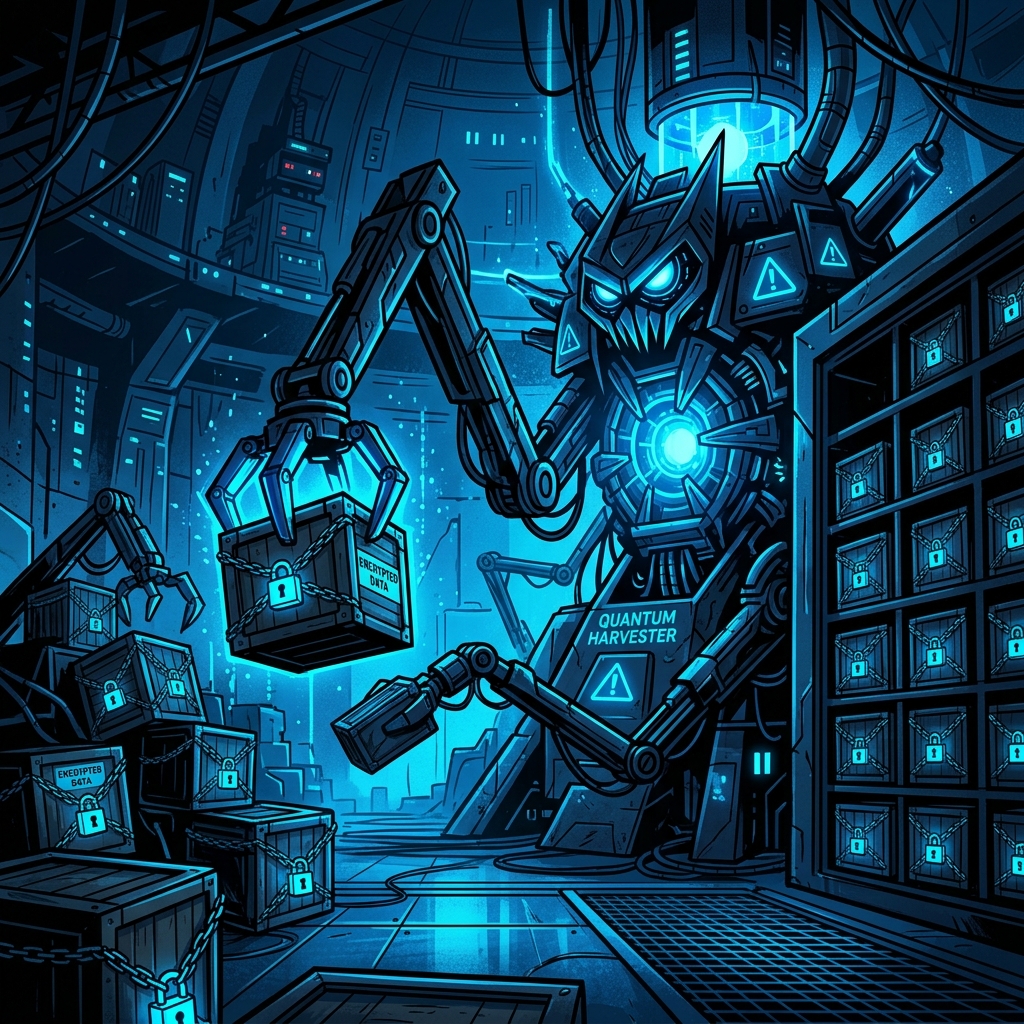
During a cybersecurity conference in London, we talked to an intelligence analytics expert. He told us something that stuck with us: “Hackers don’t care that they can’t break your password today. What matters is that they can record the traffic.” That opened our eyes. Tech is moving fast, and quantum computers in the hands of criminals will act like digital weapons of mass destruction. That is exactly why the intelligence community is sounding the alarm about “Store Now, Decrypt Later” (SNDL). We decided that in GADNET, we must cut off this possibility right now.
How does SNDL actually work?
Right now, standard encryption like RSA or elliptic curve ECC depends on really hard math problems. Factoring massive prime numbers would take a normal computer billions of years. A quantum computer running Shor’s algorithm can crack it in a few hours.
Attackers know this. State-sponsored hackers are basically vacuuming up tons of encrypted traffic - banking details, medical records, private chats. They just dump it all onto massive storage servers. They cannot read it today. But as soon as quantum tech is ready, they will instantly unlock all that historical data. And honestly, a lot of that information will still be incredibly valuable.
We built Post-Quantum Cryptography (PQC) straight into GADNET
You really shouldn’t wait a decade to fix this. The good news is that quantum-resistant encryption standards, like NIST’s FIPS 203, are already finalized.
By default, GADNET routers run hybrid TLS 1.3 packed with PQC mechanisms.
We implemented systems like X25519MLKEM768. It mixes the strong elliptic curve security we use today with the ML-KEM-768 standard. This specific setup is built from the ground up to block quantum attacks.
Because of how GADNET is built, every bit of your internal network traffic is locked down. Even if somebody successfully sniffs your data and hoards it until 2035, decrypting it will still be mathematically impossible. We made sure of that.
Your data is only as safe as the encryption you use today. With GADNET, you are basically future-proofing your home against tomorrow’s quantum threats.
Readiness for Q-Day
| Protection Method | Today (2026) | After Quantum Computers arrive (Q-Day) |
|---|---|---|
| Traditional ciphers (RSA, ECC) | Secure | Instantly broken, full data read |
| GADNET (PQC ML-KEM-768) | Secure | Still secure, mathematically resistant |